
- Jobless benefit claimants up 2.7 million since 2019 amid cross-party welfare crisis
- For every Prime Minister shown the door since 2019, the number of out of work claimants rose by 540,000 on average
- Working-age welfare spending now £42 billion a year more than in 2019 in real terms – an extra £8bn per Prime Minister on average
- Think tank calls on new PM to fix Broken Britain by unlocking “wasted potential” of millions parked on the margins
Britain has added more than half a million people to the out of work benefit caseload for every Prime Minister to occupy No10 since 2019, according to new analysis published today by the Centre for Social Justice (CSJ).
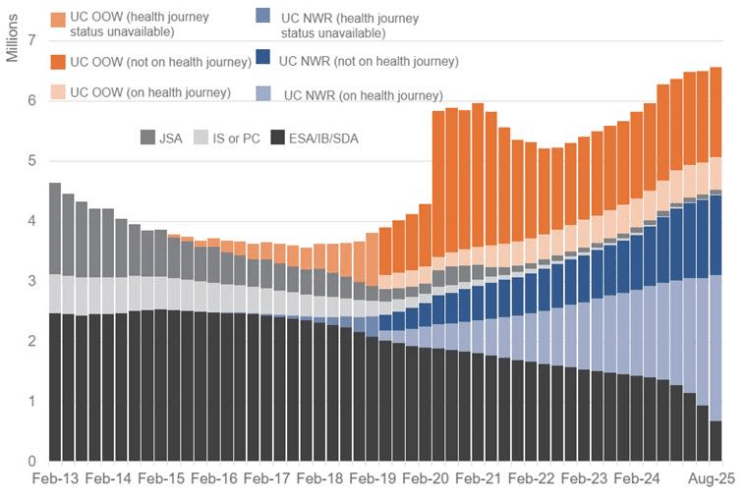
The latest DWP figures show that there are now 6.6 million people in total claiming out of work benefits, up by a staggering 2.7 million since 2019.
With the Labour Party set to unveil the country’s seventh Prime Minister in a decade, the CSJ is calling on the newest incumbent to “grasp the nettle of welfare reform” as the key to fixing broken Britain.
Sir Iain Duncan Smith, CSJ Chairman, said:
Welfare reform takes courage and time. But the rewards are enormous. Getting fewer than one quarter of those on long-term benefits back to work would generate £18 billion – enough to cut taxes by thousands, slash the deficit, or boost defence to 3 per cent of GDP.
‘Even more importantly, it would transform lives forever by extending all the advantages that come with a job. Whoever emerges as the next Prime Minister must grasp the nettle without delay.
Official forecasts show working-age benefits spending are set to rise to £144 billion by the end of the decade, a further increase of £15.5 billion between 25/26 and 30/31, with soaring sickness benefit spending one of the main drivers of growth.
The crisis is particularly acute among the young, with the latest ONS data showing that over one million – or one in seven – 16 to 24 year olds are now not in education, employment or training. In some regions, such as the North East, this rises to over one in five.
The CSJ, which has launched a new Welfare 2030 inquiry, is calling for the new Prime Minister to take a cross-government approach to get Britain working – tackling surging mental health claims, soaring costs for employers, and immigration pressures on the labour market.
The number of 16 to 34 year olds economically inactive due to a mental health condition has risen by 76 per cent since 2019, while the number of 16 to 24 year olds receiving PIP doubled over the same period according to DWP figures.
Alongside recent tax hikes on jobs, a cross-party failure to manage immigration has also fuelled the crisis, says the think tank.
The CSJ found that, since January 2020, the young non-EU migrant workforce grew by 290,000 compared to just 11,000 additional young UK-nationals, even as the number of NEETs rose by almost 200,000 over the same period.
The CSJ has also revealed that the well-trodden pathway to university is no longer working for many, with 700,000 working-age people with graduate qualifications – including 100,000 under-30s – now out of work and claiming one or more benefits.
he think tank found that the average higher-level (Level 4) apprentice now earns almost £12,500 more than a graduate from a low-value university course, despite apprenticeships falling by 40 per cent over the last decade.
Andy Burnham MP, expected to be the next Prime Minister, previously echoed calls for a technical alternative to end the NEETs crisis at a CSJ event, saying:
The Government that I was in set the 50 per cent target for university without having anything to say to the other 50 per cent, and I couldn’t support that then and I didn’t.
‘The CSJ has begun to change the conversation in this country about an education that works for all, and it chimes with everything we have tried to do in Greater Manchester.
‘What we are trying to do is build an academic and technical parity in an education system that offers everyone a route.

Joe Shalam, Policy Director at the Centre for Social Justice, said:
The Westminster chaos that has come to define the last decade has coincided with rising welfare dependency, growing disillusionment with our education system, and the ensuing scandal of wasted potential.
‘The next occupant of No 10 must immediately commence a programme of reform, expanding meaningful support instead of blunt welfare payments and building an education system that equips young people for adulthood.
‘If the next Prime Minister wants to succeed where their predecessors failed, they must stop managing decline and start fixing Broken Britain.

The CSJ has called for the government to tighten mental health benefits to more severe cases, saving £7.4 billion and reinvesting £1 billion to expand NHS talking therapies, social prescribing and back to work support.
ENDS
Methodology
CSJ analysis of DWP Stat-Xplore shows there were 6,575,154 people in Great Britain on out of work benefits in November 2025 (the latest data), compared to roughly 3,891,912 in May 2019 (see Figure 1). Dividing the increase (of 2,683,242) by the five prime ministers who lost their jobs over the same period (May, Johnson, Truss, Sunak, Starmer) produces an increase of 536,648 on average.
Figure 1: Out of Work, Working Age, DWP Benefit Claimants, Great Britain, February 2013 to August 2025
Source: DWP, 2026
CSJ analysis of HMRC payroll data found that between January 2020 and December 2025, non-EU under-25 payrolled employment increased from 81,500 to 370,900, a rise of 289,400 or 355 per cent. UK-national under-25 payrolled employments increased from 3,841,500 to 3,852,300, a rise of 10,800.
Saving £18 billion by helping one million people on long-term benefits back to work is calculated using DWP analysis which estimates that every 10,000 claimants moving into full-time work improves the public finances by around £180 million per year through a combination of higher tax receipts and lower benefit spending. One million is less than a quarter of the 4.4m people on out of work benefits who are not currently expected to look for work.
The figure of approximately 700,000 graduates out of work and claiming benefits is derived from analysis of the Labour Force Survey (July–September 2025). Using the LFS weights, the CSJ estimated the number of individuals aged 16–64 whose highest qualification is degree level or above, who are out of work, and who report claiming one or more benefits. This returned a weighted population estimate of 706,575.